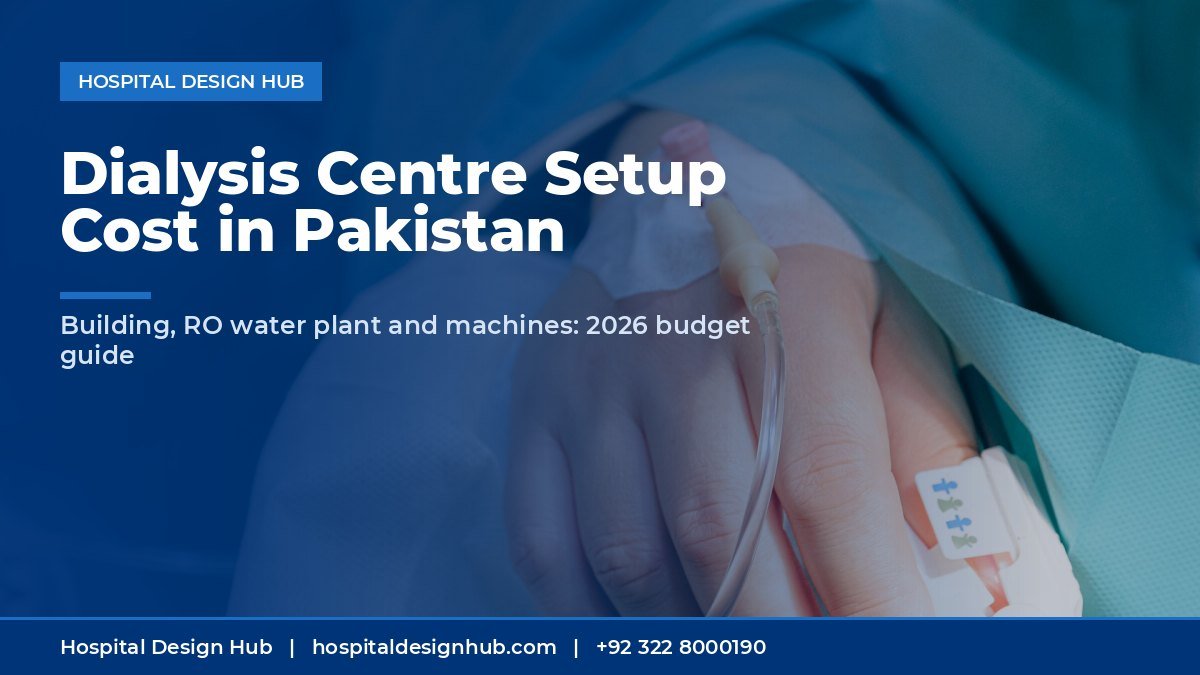
Dialysis Centre Setup Cost in Pakistan: Building, RO & Machines
Chronic kidney disease is rising steadily in Pakistan, driven by diabetes, high blood pressure and late diagnosis. Thousands of patients need haemodialysis two or three times every week for the rest of their lives, and in many cities and districts there are simply not enough dialysis stations. For hospitals, trusts and investors, a dialysis centre is both a vital public service and a sustainable healthcare business.
But what does it actually cost? This guide breaks down dialysis centre setup cost in Pakistan for 2026, covering space, building works, the RO water plant, dialysis machines and chairs, other equipment, staffing, running costs and licensing. The figures are indicative to help you plan a realistic budget before you approach suppliers, donors or banks.
⚡ Quick Answer
An indicative budget for a 10-station haemodialysis centre in Pakistan in 2026 is roughly PKR 6–12 crore excluding land, depending mainly on the brand and number of dialysis machines, the RO plant specification, and the building works. The machines and RO plant usually make up the largest share. A 10-station unit typically needs around 2,500–3,500 ft², and with two or three shifts a day it can serve roughly 40–60 regular patients on twice- or thrice-weekly schedules. These are planning estimates only; always obtain current quotations.
🏢 About Hospital Design Hub
Hospital Design Hub is a specialist hospital design and construction company, established in 2000 and focused on healthcare infrastructure: design, construction, consultancy and project management, and the renovation and maintenance of hospital facilities. With more than 50 successfully completed projects, our team has worked on healthcare facilities across Pakistan, including projects such as LDMC, MCH Islamkot, King Edward Medical University / Mayo Hospital, and UOL Hospital Lahore.
We design and build dialysis units inside hospitals and as standalone centres, coordinating RO water systems, electrical supply, drainage and patient layout so the unit is safe from day one.
🩺 What Does a Dialysis Centre Need?
A haemodialysis unit is essentially a specialised day-care facility where patients spend around four hours per session connected to a dialysis machine. The key spaces are:
- Dialysis hall or bays with a dialysis machine, reclining chair or bed, and services at each station.
- Isolation stations or a separate room for patients positive for hepatitis B (and, depending on policy, hepatitis C or HIV), with dedicated machines.
- Nurse station with clear visibility of all stations.
- RO water treatment plant room supplying purified water to every machine.
- Reception, waiting and patient toilets.
- Doctor’s consultation room.
- Clean store for dialysers, bloodlines and concentrates, and a dirty utility / waste room.
- Staff areas: change rooms, rest room and office.
- Emergency trolley with defibrillator and oxygen access.
For layout principles, see our guide to kidney and dialysis centre design.
📏 How Much Space Does a Dialysis Centre Need?
| Centre Size | Indicative Total Area | Approx. Patients Served (2–3 shifts) |
|---|---|---|
| 5 stations | ~1,400–2,000 ft² | ~20–30 |
| 10 stations | ~2,500–3,500 ft² | ~40–60 |
| 20 stations | ~4,500–6,500 ft² | ~80–120 |
Each dialysis station typically needs around 8–10 m² (roughly 90–110 ft²) for the chair, machine and staff access, plus support spaces. Ground-floor locations are strongly preferred because many patients are elderly, diabetic or weak after dialysis.
💰 Dialysis Centre Setup Cost Breakdown (Indicative 2026, 10 Stations)
| Item | Basis | Indicative Range (PKR) |
|---|---|---|
| Dialysis machines (10 + 1 backup) | Per machine, depending on brand and features | ~2.8–5.5 crore |
| Dialysis chairs / recliners | Per station | ~15–40 lakh |
| RO water treatment plant with loop distribution | Sized for stations and growth | ~25–70 lakh |
| Civil works, finishes and fit-out | ~PKR 5,000–10,000 / ft² for fit-out of existing shell | ~1.3–3.5 crore |
| HVAC | Comfort cooling and ventilation | ~25–60 lakh |
| Electrical, UPS and generator connection | Dedicated circuits per station, backup power | ~25–60 lakh |
| Medical gas / oxygen and suction | Portable or pipeline | ~5–20 lakh |
| Other equipment (monitors, defibrillator, weighing scales, furniture, IT) | Lump sum | ~20–50 lakh |
| Design, approvals and licensing | Lump sum | ~10–30 lakh |
| Initial consumable stock and working capital | 2–3 months | Varies with patient load |
| Total (excluding land and building purchase) | ~PKR 6–12 crore |
Indicative estimates for planning only, based on typical Pakistani market conditions. Machine and RO prices depend strongly on brand, specification and exchange rates. Refurbished machines reduce cost but should be carefully assessed for reliability and service support. Always obtain current quotations.
💧 The RO Water Plant: The Most Critical System
Each haemodialysis session exposes the patient’s blood to a very large volume of dialysis fluid through the dialyser membrane. If the water used to make that fluid contains chemicals, bacteria or endotoxins, patients can suffer serious harm. Pakistan’s municipal and groundwater supplies vary widely in hardness, salinity and contamination, so water treatment is the heart of any dialysis centre.
A typical dialysis water treatment system includes:
- Raw water storage and booster pumps.
- Pre-treatment: sediment filters, multimedia filters, water softener and activated carbon (to remove chlorine and chloramine).
- Reverse osmosis unit, often double-pass for high-quality water.
- Product water distribution loop in hygienic piping to each station, designed to avoid dead legs where bacteria can grow.
- Disinfection provisions (heat or chemical) for the RO and loop.
- Monitoring and testing of conductivity, chlorine and microbiological quality.
Water quality for dialysis is commonly assessed against international standards such as those published by ISO for dialysis water and fluids. We cover RO design in detail in our guide to RO water plants for dialysis units.
📐 Layout and Design Essentials
- Clear sightlines: nurses must see every patient from the nurse station, because blood pressure drops and needle dislodgement can happen suddenly.
- Services at every station: treated water outlet, drain point, multiple electrical sockets on dedicated circuits, and access to oxygen and suction.
- Floor drains and drainage: sized for dialysis effluent, with proper slopes and traps.
- Hygienic finishes: seamless vinyl flooring, washable walls, easy-clean surfaces.
- Patient comfort: reclining chairs, TV or entertainment, temperature control and privacy curtains.
- Isolation provision: separate area and machines for hepatitis B positive patients.
- Accessibility: ramps, wide doors and accessible toilets.
👩⚕️ Staffing and Running Costs
Setup cost is only half of the financial picture. Running costs include:
| Running Cost | Notes |
|---|---|
| Staff salaries | Nephrologist oversight, medical officer, dialysis nurses and technicians per shift, RO/biomedical technician, reception and support staff |
| Consumables | Dialysers, bloodlines, fistula needles, concentrates, medicines; the largest variable cost per session |
| Electricity | Machines, RO plant and HVAC running long hours |
| Water | Significant volumes for RO and dialysis |
| Maintenance | Machine servicing, RO membranes and filters, calibration |
| Waste disposal | Infectious waste management |
Many centres operate through a mix of paid sessions, health insurance programmes, government schemes and charitable support. Financial sustainability depends on high machine utilisation across two or three shifts, careful consumable management and reliable equipment.
⚖️ Standalone Centre vs Hospital-Based Unit
| Factor | Standalone Dialysis Centre | Hospital-Based Unit |
|---|---|---|
| Setup cost | Higher (needs its own utilities and support) | Lower (shares generator, lab, pharmacy) |
| Emergency backup | Needs transfer arrangement with a hospital | Immediate access to ER and ICU |
| Patient convenience | Can be located near patients | Depends on hospital location |
| Referrals | Relies on nephrologists and word of mouth | Built-in referrals from hospital |
| Best for | Underserved neighbourhoods, charities, franchises | Existing hospitals expanding services |
✅ Pros and Cons of Starting a Dialysis Centre
| 👍 Pros | 👎 Cons |
|---|---|
|
|
💡 Ways to Reduce Setup Cost Without Compromising Safety
- Start with fewer stations and design the RO plant, electrical capacity and layout for future expansion.
- Locate in an existing building on the ground floor with good access, avoiding new construction where possible.
- Standardise machines on one brand with reliable local service.
- Invest properly in RO, because water problems are the most dangerous and expensive to fix later.
- Add solar to reduce electricity costs over time.
- Use a PEB or prefab building for a standalone centre where land is available; see prefab hospital wards and PEB buildings.
📜 Licensing and Approvals
Dialysis centres are healthcare establishments and must be registered and licensed by the relevant provincial healthcare regulator, such as the Punjab Healthcare Commission in Punjab. Inspectors typically review infrastructure, infection control, water treatment and testing records, staffing, equipment maintenance and waste management. Designing the centre to the regulator’s standards from the start avoids costly changes later. Read our guide to PHC layout guidelines. Useful clinical references are also available from the International Society of Nephrology.
🧮 Worked Example: Budgeting a 10-Station Centre
To see how the numbers come together, consider an illustrative 10-station dialysis centre fitted out in a rented ground-floor space of about 3,000 ft² in a Punjab city:
- Machines: 11 new machines (10 plus one backup) from a mid-range brand with local service support, assumed at around PKR 35 lakh each, giving roughly PKR 3.9 crore.
- Chairs: 10 reclining dialysis chairs at around PKR 2.5 lakh each, about PKR 25 lakh.
- RO plant: a double-pass system with pre-treatment and a hygienic loop sized for 15 stations to allow growth, around PKR 45 lakh.
- Fit-out: 3,000 ft² at around PKR 7,000 per ft² for partitions, finishes, plumbing, drainage, lighting and ceilings, roughly PKR 2.1 crore.
- HVAC, electrical and UPS: around PKR 80 lakh combined.
- Other equipment, IT and furniture: around PKR 35 lakh.
- Design, approvals and contingency: around PKR 60 lakh.
The illustrative total is therefore roughly PKR 8.5 crore before working capital, which sits in the middle of the indicative range. Changing the machine brand or choosing refurbished units moves the total significantly, which is why the equipment decision should be made early.
📅 How Long Does It Take to Open a Dialysis Centre?
| Stage | Typical Duration |
|---|---|
| Site selection and feasibility | 2–6 weeks |
| Design and equipment selection | 3–6 weeks |
| Approvals and ordering long-lead equipment | 4–8 weeks (overlapping) |
| Fit-out construction | 8–14 weeks |
| RO installation, water testing and machine installation | 3–6 weeks (overlapping) |
| Staff training, licensing inspection and opening | 2–4 weeks |
| Total (typical fit-out project) | ~4–7 months |
Water testing is often the step that delays opening. The RO system should be installed and running early enough to complete chemical and microbiological tests before patients start treatment.
✅ Pre-Opening Checklist for a Dialysis Centre
- RO plant commissioned and water test results within acceptable limits.
- Loop disinfection procedure documented and tested.
- All machines installed, calibrated and tested by the supplier.
- Dedicated electrical circuits and UPS tested; generator changeover verified.
- Isolation area and dedicated machines ready for hepatitis B positive patients.
- Emergency trolley, defibrillator and oxygen available and checked.
- Infection control policies, cleaning schedules and waste management in place.
- Staff trained in dialysis procedures, emergencies and machine alarms.
- Patient records system and consent forms ready.
- Licensing documents submitted and inspection completed.
A centre that ticks every item on this list opens smoothly and builds patient trust from the first day.
❓ Frequently Asked Questions
How much does it cost to set up a dialysis centre in Pakistan?
As an indicative 2026 estimate, a 10-station haemodialysis centre typically costs around PKR 6–12 crore excluding land, depending on machines, RO plant and building works.
How much space does a 10-station dialysis centre need?
Roughly 2,500–3,500 square feet, including dialysis stations, isolation area, RO plant room, nurse station, waiting, stores and staff areas.
How many patients can a 10-station dialysis centre serve?
With two to three shifts a day, a 10-station centre can typically serve around 40–60 regular patients on twice- or thrice-weekly schedules.
Why is an RO plant essential for dialysis?
Dialysis fluid is made from treated water that comes into close contact with the patient’s blood through the dialyser. RO treatment removes chemicals and contaminants that could harm patients.
Do hepatitis B patients need separate dialysis machines?
Yes. Standard practice is to dialyse hepatitis B positive patients in a separate area with dedicated machines to prevent transmission.
What is the most expensive part of a dialysis centre?
Dialysis machines and the RO water treatment system usually account for the largest share of setup costs, while consumables are the largest running cost.
Can a dialysis centre be set up in an existing building?
Yes. Ground-floor spaces with good access, adequate floor area, drainage, electrical capacity and space for the RO plant are often suitable after fit-out.
Does a dialysis centre need a licence in Pakistan?
Yes. Dialysis centres must be registered and licensed by the relevant provincial healthcare commission and meet its infrastructure and service standards.
📞 Planning a Dialysis Centre?
Tell us how many stations you plan and your location, and our team will prepare a layout, RO concept and indicative budget for your dialysis centre.
Call: +92 322 8000190 | Email: info@hospitaldesignhub.com | Web: hospitaldesignhub.com