
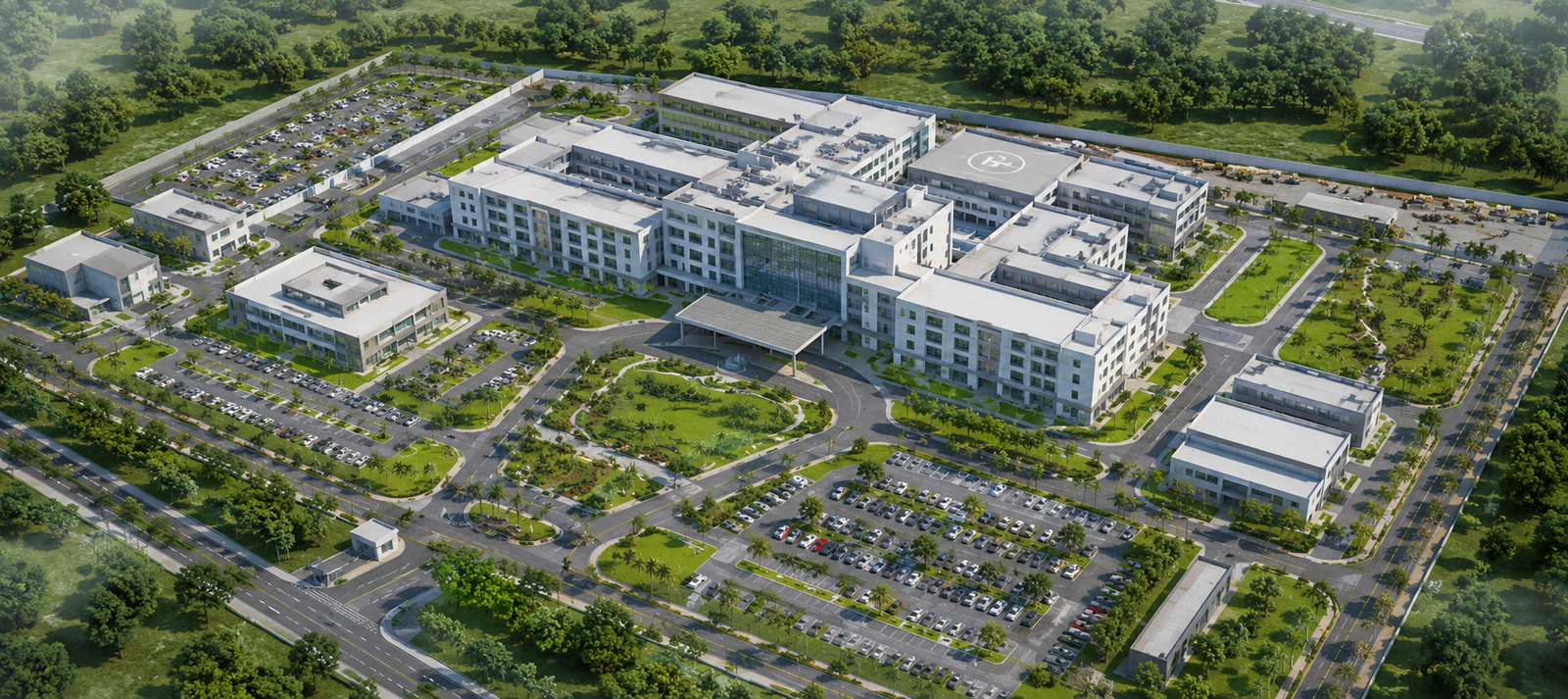
Master Planning in Pakistan | Hospital Design Hub
Strategic Master Planning in Pakistan for Future-Ready Healthcare Campuses
Pakistan’s healthcare leaders face a recurring nightmare: a hospital that was adequate five years ago now suffers from chronic overcrowding, inefficient patient flow, and departments crammed into spaces never designed for them. In Lahore, Karachi, and Islamabad, medical directors describe the same painful cycle – adding a new MRI machine means relocating three offices, expanding the emergency department requires demolishing a storage wing, and there is simply no room for the cardiac center the community desperately needs. This chaos stems from one missing element: strategic master planning in Pakistan that anticipates growth rather than reacting to crises.
Hospital Design Hub introduces disciplined master planning in Pakistan for healthcare facilities of all sizes. Master planning is the critical first step that maps out not just your first building, but your entire campus evolution over 10, 20, or 30 years. We analyze your clinical service projections, patient volume forecasts, staffing requirements, and land constraints to create a phased development roadmap. Whether you are developing a greenfield hospital campus in Islamabad, expanding a downtown Karachi medical center, or planning a medical college complex in Faisalabad, our master planning services ensure every building has its logical place, every department connects efficiently to related services, and every construction dollar contributes to a coherent long-term vision rather than short-term fixes.
What Is Professional Master Planning in Pakistan for Healthcare?
Professional master planning in Pakistan for healthcare is the strategic process of organizing land, buildings, infrastructure, and clinical services into a cohesive, efficient, and expandable campus. Unlike single-building design, master planning takes a holistic view of your entire property – existing structures, vacant land, utility corridors, parking requirements, and future construction zones. A healthcare master plan answers fundamental questions: Where should the emergency department be located relative to ambulance access? How will patients move from parking to outpatient clinics without crossing infection-sensitive zones? Where will you build the new surgical wing in five years without disrupting current operations? Where should support services like kitchens and laundries be positioned for efficient logistics?
Master planning in Pakistan matters more than ever due to the country’s rapid healthcare expansion. Private hospital chains are acquiring land in major cities. Medical colleges require attached teaching hospitals with dedicated student zones. Diagnostic chains need centralized laboratories serving multiple collection points. Each of these scenarios demands master planning that coordinates phasing, budgets, and operational continuity. Without proper master planning, healthcare facilities in Pakistan develop organically – which usually means chaotically – with disconnected buildings, inefficient circulation, and expensive retrofits. Hospital Design Hub brings disciplined master planning that aligns with Pakistan’s healthcare regulations, climate considerations, and construction market realities while preparing your campus for decades of service.
About Hospital Design Hub – Pakistan’s Healthcare Planning Authority
Hospital Design Hub has emerged as Pakistan’s leading specialist in healthcare master planning, architecture, and construction. We are not general planners who occasionally accept healthcare projects – we are dedicated medical facility strategists who understand that hospitals are the most complex buildings ever constructed. Our master planning team includes healthcare architects, hospital operations consultants, medical equipment planners, and civil engineers who collaborate to create campus development strategies that work clinically and financially.
Our master planning in Pakistan extends across the entire nation, from Lahore’s dense urban medical districts to Karachi’s sprawling healthcare corridors and Islamabad’s planned medical zones. We have developed master plans for private hospitals, public healthcare facilities, medical colleges, diagnostic laboratory networks, and rehabilitation centers. When you engage Hospital Design Hub, you receive a master plan that balances immediate construction needs with long-term strategic vision, optimizes patient flow and staff efficiency, and provides a realistic phased budget that respects your capital constraints while protecting your future options.
Comprehensive Master Planning Applications for Healthcare Facilities
Greenfield Hospital Campus Master Planning
Developing a hospital on undeveloped land offers rare opportunities to get everything right from the start. Our greenfield master planning in Pakistan creates complete campus layouts including clinical buildings, support services, staff housing, parking, landscaping, and utility networks. We position the emergency department for rapid ambulance access, outpatient clinics near public parking, and inpatient towers with optimal views and ventilation. Future expansion zones are reserved for planned growth without disrupting completed buildings.
- Site analysis including topography, utilities access, and orientation
- Clinical adjacency diagrams for efficient department relationships
- Phased construction sequencing from Phase 1 through Phase 4
- Stormwater management and landscape integration
- Staff and visitor parking allocation based on peak demand projections
Urban Healthcare Campus Expansion Planning
Expanding hospitals in Pakistan’s dense cities requires creative master planning solutions. Our urban expansion master planning identifies underutilized spaces – surface parking lots, outdated single-story buildings, or adjacent land parcels – and develops strategies to build vertically or infill between existing structures. We plan construction phasing that keeps your hospital fully operational during building, with temporary relocations, noise control measures, and dust containment protocols for patient safety.
- Air rights analysis for vertical expansion above existing buildings
- Temporary department relocation planning during construction
- Adjacent land acquisition feasibility studies
- Underground parking and utility tunnel development
- Community impact mitigation for urban construction sites
Medical College and Teaching Hospital Master Planning
Medical colleges attached to teaching hospitals have unique spatial requirements. Our medical campus master planning separates academic zones from clinical areas while maintaining convenient access for students rotating through wards. We plan lecture theaters, simulation laboratories, skills training centers, and student hostels in logical relationship to clinical teaching departments. Library and research spaces are positioned for quiet study away from emergency department noise.
- Academic-to-clinical circulation for student rotations
- Simulation center integration with adjacent clinical departments
- Faculty offices near teaching wards and outpatient clinics
- Student hostel proximity with secure evening access pathways
- Research laboratory zones with shared core facilities
Diagnostic Laboratory Network Master Planning
Diagnostic chains with multiple collection centers require master planning that coordinates central processing laboratories with satellite locations. Our diagnostic network master planning determines optimal locations for high-volume automated testing equipment, specimen transport logistics, and result reporting workflows. We plan refrigeration capacity for reagent storage, dedicated areas for hazardous waste management, and specimen reception zones separate from patient waiting areas.
- Hub-and-spoke logistics for specimen transport from collection points
- Automated track systems for high-volume chemistry and hematology
- Bio-safety level containment planning for microbiology
- Cool chain infrastructure for temperature-sensitive specimens
- Data center proximity for laboratory information systems
Multi-Specialty Clinic and Ambulatory Care Master Planning
Ambulatory care centers and multi-specialty clinics need efficient layouts that minimize patient travel distances. Our clinic master planning groups related specialties – cardiology with pulmonary medicine, orthopedics with physical therapy, pediatrics with well-child services. We plan shared support spaces including registration, waiting areas, phlebotomy, and diagnostic imaging to serve multiple specialties efficiently while maintaining privacy and infection control.
- Specialty clustering for patient convenience and equipment sharing
- Centralized registration and checkout for reduced queuing
- Modular exam room designs adaptable for different specialties
- Minor procedure rooms with sterile supply access
- Staff support zones including dictation and break rooms
Healthcare Infrastructure and Utility Master Planning
Behind every great hospital is invisible infrastructure that must be planned first. Our utility master planning maps out central utility plants for heating, cooling, and emergency power; medical gas storage and distribution systems; water treatment and storage; sewage and waste management; and information technology backbone networks. We plan redundant feeds and looped systems that keep your hospital running even when one utility path fails.
- Centralized chiller and boiler plant sizing for ultimate build-out
- Emergency generator capacity planning for critical and life-safety loads
- Medical gas manifold rooms with cylinder storage and bulk tank provisions
- Water storage for 48-hour autonomous operation
- IT backbone with redundant fiber optic pathways
Hospital Design Hub vs. Conventional Master Planning Methods
| Feature | Hospital Design Hub Solution | Conventional Method |
|---|---|---|
| Cost Efficiency | Phased planning avoids premature construction by 30-40% | Piecemeal expansion costs significantly more long-term |
| Planning Time | Comprehensive master plan delivered in 8-12 weeks | Fragmented planning extending over 6-12 months |
| Patient Flow Planning | Circulation modeling before any construction begins | Flow issues discovered after buildings are complete |
| Future Expansion Capability | Land and infrastructure reserved for 20-year growth | No reserved capacity, requiring expensive retrofits |
| Clinical Adjacencies | Evidence-based department relationships planned | Random adjacencies creating inefficient workflows |
| Utility Capacity | Central plants sized for ultimate campus build-out | Undersized utilities requiring costly replacement |
| Regulatory Compliance | PEC, PSQCA, and Healthcare Commission integration | Compliance addressed reactively after design |
| Phased Budgeting | Realistic capital costs for 5, 10, and 15-year horizons | Unpredictable costs with no long-range planning |
| Parking Planning | Structured and surface parking for ultimate demand | Chronic parking shortages after first expansion |
| Infrastructure Coordination | All utilities planned and routed before construction | Retrofitted utilities causing operational disruptions |
| Land Use Optimization | Maximum buildable area utilization with setbacks | Inefficient land use leaving valuable space unused |
| Environmental Impact | Sustainable stormwater and landscape integration | Limited environmental consideration in planning |
Figures are based on healthcare infrastructure project benchmarks and may vary depending on project scope and medical requirements.
Our Master Planning Process – From Vision to Phased Roadmap
1. Initial Consultation – We meet with your leadership team to understand your clinical vision, service line projections, patient volume forecasts, and capital budget constraints. This strategic conversation shapes every subsequent decision in your master planning in Pakistan project.
2. Site Analysis and Due Diligence – Our team assesses your property including topography, soil conditions, utility availability, zoning restrictions, and easements. We identify opportunities and constraints before any planning begins, saving you from costly surprises during development.
3. Clinical Service Planning – We work with your medical leadership to project which clinical services will grow, which new services will be added, and what space each department requires. This clinical forecast drives all master planning decisions about building sizes and adjacencies.
4. Existing Facility Assessment – For expansion projects, we thoroughly document your current buildings including structural conditions, mechanical system capacities, and space utilization. We identify what can be renovated versus what must be replaced.
5. Conceptual Master Plan Development – Our planners create multiple campus layout options showing building locations, parking configurations, utility routes, and landscape zones. We present these options for your review and refinement before moving to detailed planning.
6. Phasing and Financial Modeling – We develop realistic construction phases sequenced to maintain hospital operations during building. Each phase includes detailed cost estimates, construction duration projections, and temporary operation plans.
7. Final Master Plan Delivery and Implementation Support – We provide complete master plan documentation including site plans, utility maps, phasing diagrams, budget forecasts, and regulatory submission packages. We remain available to support you through each construction phase as your trusted planning partner.
Ready to develop a strategic master plan for your healthcare campus? Hospital Design Hub is ready to guide you from vision to phased reality. Contact our team to schedule a master planning consultation.
🏥 Website: https://hospitaldesignhub.com/
✉️ Email: info@hospitaldesignhub.com
Whether you need complete master planning in Pakistan for a new hospital campus or strategic expansion planning for an existing medical center, we are ready to discuss your long-term vision.
Why Healthcare Leaders Across Pakistan Choose Hospital Design Hub for Master Planning
Pakistan’s healthcare sector is evolving rapidly, with private hospital chains expanding, medical colleges opening teaching hospitals, and existing facilities struggling to keep pace with patient demand. This growth has created urgent demand for master planning in Pakistan that thinks strategically about the future rather than reacting to immediate space shortages. Hospital Design Hub has responded by developing master planning expertise that general architectural firms simply cannot offer.
Hospital owners in Lahore value our understanding of the city’s competitive healthcare market and the need for phased expansion that maintains operational continuity. Healthcare systems in Karachi trust our experience planning high-density medical campuses on expensive urban land. Teaching hospitals in Islamabad and Rawalpinning rely on our expertise integrating academic and clinical spaces. From Faisalabad’s growing medical district to Multan’s expanding specialty hospital networks, we deliver master plans that respect capital constraints while protecting future options. Visit our Healthcare Projects in Pakistan portfolio to see master planning results across the nation.
Key Numbers That Define Our Master Planning Excellence
Hospital Design Hub brings measurable strategic capability to every master planning in Pakistan project we undertake. Our nationwide master planning coverage extends across all major cities including Lahore, Karachi, Islamabad, Rawalpindi, Faisalabad, Multan, Peshawar, and Sialkot. We have developed master plans for multiple healthcare facility types including tertiary care hospitals, secondary care centers, medical teaching institutions, diagnostic laboratory networks, ambulatory care campuses, and rehabilitation centers. Our medical planning expertise incorporates international healthcare design standards while adapting practically for Pakistan’s regulatory environment, climate conditions, and construction market. We maintain modern healthcare planning standards including evidence-based department adjacencies, patient-centered circulation, and staff efficiency optimization. Our end-to-end master planning services mean you receive a complete strategic document from site analysis through phased budgeting and regulatory coordination – all from one integrated team.
Related Healthcare Planning and Design Services
Beyond comprehensive master planning in Pakistan, Hospital Design Hub offers a complete suite of specialized healthcare planning and execution services. A strategic master plan must be implemented through disciplined architecture, construction, and interior design – services we provide as an integrated team. Our related services ensure your master plan translates successfully from paper to built reality.
We provide Hospital Architecture Design that brings master plan concepts into detailed building drawings, and our Hospital Construction services deliver each phase on time and within budget. Our ICU Design and Operation Theater Design specialists create the detailed room layouts that master planning allocates space for. Diagnostic Lab Planning ensures your laboratory facilities meet accreditation standards, while Healthcare Interior Design transforms planned spaces into healing environments. We also provide Medical Gas System Planning, deliver Modular Healthcare Buildings for rapid implementation, offer Clinic Design Solutions, and provide ongoing Healthcare Master Planning updates as your campus evolves. Explore all services at Hospital Design Hub Services.
Master Planning Standards and Regulatory References
Hospital Design Hub aligns all master planning in Pakistan with recognized national and international standards. The Pakistan Engineering Council (PEC) provides our professional planning framework, ensuring all infrastructure designs meet mandatory safety requirements. We follow Pakistan Standards & Quality Control Authority (PSQCA) guidelines for construction materials, utility systems, and building codes. International best practices from the World Health Organization (WHO) inform our healthcare facility planning standards including infection control zoning, emergency preparedness, and patient safety features. International Organization for Standardization (ISO) standards for healthcare facility management and quality planning guide our master planning processes and documentation. By integrating these references into every master plan, we deliver campus development strategies that are safe, compliant, and prepared for the future of medicine in Pakistan.
Frequently Asked Questions About Master Planning in Pakistan
1. What is master planning in Pakistan for healthcare facilities?
Master planning in Pakistan for healthcare is the strategic process of organizing land, buildings, and infrastructure into an efficient, expandable campus. It creates a phased development roadmap for 10-20 years, identifying where buildings should be located, how utilities should be routed, and which departments should be adjacent for optimal patient flow.
2. How much does master planning in Pakistan cost?
Master planning fees typically range from PKR 500,000 to 2,500,000 depending on campus size and complexity. Small clinics pay less, while large hospital campuses or medical colleges pay more. This investment typically saves 10-20 times its cost by avoiding inefficient construction and costly retrofits later.
3. How long does it take to complete a healthcare master plan?
Most healthcare master plans require 8-12 weeks from initial consultation to final delivery. The timeline includes site analysis, clinical service planning, concept development, phasing studies, and financial modeling. Complex campuses with multiple existing buildings may require 12-16 weeks for thorough assessment.
4. Is master planning in Pakistan suitable for existing hospitals or only new campuses?
Master planning is equally valuable for existing hospitals. We assess your current buildings, identify underutilized spaces, develop expansion strategies for constrained urban sites, and create phased renovation plans that keep your hospital operational during construction. Existing facilities benefit tremendously from strategic master planning.
5. Can a master plan accommodate specific medical department requirements?
Absolutely. Clinical service planning is the foundation of our master planning process. We work with your medical leadership to understand each department’s unique space needs, equipment requirements, patient volumes, and adjacency preferences. Your master plan reflects your specific clinical services, not generic assumptions.
6. Does Hospital Design Hub handle master planning only or also implementation?
We provide both master planning and complete implementation services including architecture, engineering, construction, and interior design. This integrated approach ensures your master plan’s vision is carried through to every built detail without the coordination gaps that occur when using separate planning and construction firms.
7. Are master plans compliant with Pakistan healthcare safety standards?
All our master plans comply with Pakistan Engineering Council requirements, fire safety codes, Healthcare Commission standards, and international guidelines including WHO recommendations for healthcare facility planning. We provide complete documentation for regulatory approvals and future accreditation processes.
8. What is the typical planning horizon for a healthcare master plan?
Our master plans typically project 15-20 years forward, with detailed phasing for years 1-5, conceptual planning for years 6-10, and directional guidance for years 11-20. We recommend master plan updates every 3-5 years to adjust for changing market conditions, clinical service lines, and patient volume projections.
9. Which cities in Pakistan does Hospital Design Hub serve for master planning?
We serve all major Pakistani cities including Lahore, Karachi, Islamabad, Rawalpindi, Faisalabad, Multan, Peshawar, Sialkot, and surrounding areas. Our planning team travels nationwide for site assessments, stakeholder interviews, and master plan presentations regardless of your campus location.
10. How can I get a master planning consultation for my healthcare campus?
Contact Hospital Design Hub through our website or email to schedule an initial consultation. Share your campus details – location, existing buildings (if any), land area, clinical services planned, and growth expectations – and we will arrange a meeting to discuss your vision and provide preliminary master planning guidance.
Start Your Healthcare Campus Master Planning Journey Today
Your vision for a future-ready healthcare campus deserves professional master planning in Pakistan that thinks strategically about growth, optimizes patient and staff flow, and protects your capital investment through disciplined phasing. Hospital Design Hub brings together healthcare strategists, architects, and operations experts who collaborate to create master plans that balance clinical excellence with financial reality. Whether you are developing a greenfield hospital campus, expanding a downtown medical center, or planning a medical college complex, our integrated master planning approach saves you money, prevents costly mistakes, and delivers a campus that will serve your community for decades.
Take the first step toward strategic healthcare campus development today. Visit our website to explore our master planning portfolio and case studies. Send us an email describing your campus and vision, and we will respond promptly to schedule a consultation. From initial visioning sessions to detailed phased roadmaps, Hospital Design Hub stands ready as your dedicated partner in healthcare infrastructure strategy across Pakistan.
📐 Website: https://hospitaldesignhub.com/
📧 Email: info@hospitaldesignhub.com
Let us plan healthcare spaces that grow, adapt, and endure – together.
Ready to Transform Your Healthcare Facility?
At Hospital Design Hub, we specialize in creating innovative, patient-centered designs that enhance both functionality and comfort. Whether you’re planning a new hospital, renovating an existing facility, or developing specialized medical spaces, our team of expert architects and designers is here to bring your vision to life.